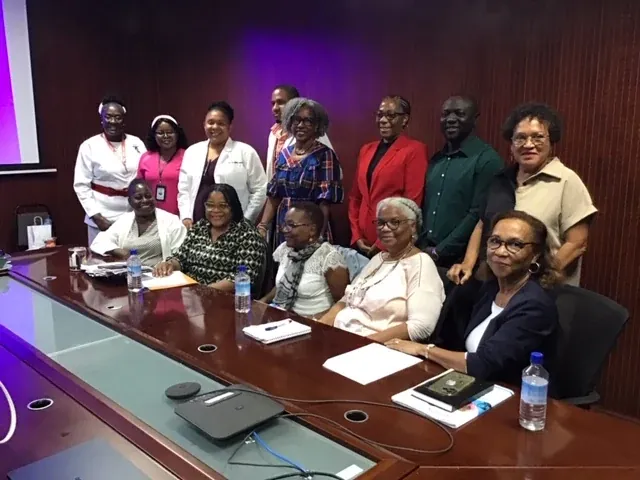
On 24 and 25 March 2026, the CAREST network and the MADREPORE 971 association held two working days at the Dominica China Friendship Hospital in Roseau with Dominica’s health professionals and health authorities. The meeting, whose programme had been prepared locally, led to the joint adoption of four priorities for cooperation on sickle cell disease.

Two days at the Dominica China Friendship Hospital
On 24 and 25 March 2026, under the title Building Bridges for Sickle Cell Care, two working days were held in Roseau at the Dominica China Friendship Hospital, where the island’s sickle cell patients receive their follow-up care.
The programme had been prepared in Dominica by Dr Clarissa A. Hamilton, MD, MMed-Pediatrics, a paediatrician at the hospital.
The discussions took the form of a round table between the Dominican and Guadeloupean teams, co-led by Dr Hamilton and Dr Marie Pétras. The agreed programme was followed over both days.
Why Dominica
Sickle cell disease is a public health problem throughout the Caribbean, and the two territories bear its burden only a few dozen kilometres apart.
Regional exchanges on the disease began well before March 2026, and Dominica has taken part in them for years. Dr Hamilton points to what was missing: a lasting, formalised framework capable of turning these relationships into services that patients can access.
Dominican patients already travel to Guadeloupe and Martinique for specialist care that is unavailable at home. Guadeloupe sees the same reality from its side, since it receives them regularly. Two neighbouring territories, patients moving between them, no common framework: the mission was undertaken to build one.
A mission built together
The meeting brought together a joint delegation from CAREST, lead partner of the SHELTER programme, and MADREPORE 971, a programme partner, with the Dominican stakeholders in patient care: the hospital’s chief executive and medical directors, paediatricians and a neonatologist, an internal medicine physician, the Ministry of Health’s primary care directorate, the acting head of the national reference laboratory and the nursing manager.
Dr Hamilton, who brought these professionals together, is also a member of CAREST’s working group on newborn screening. Several participants were therefore already working together remotely. The mission brought them together in person.
The two Guadeloupean organisations each came with their own purpose. MADREPORE 971, to share the experience of patient follow-up built up at the cross-disciplinary sickle cell unit of the Guadeloupe University Hospital. CAREST, to pursue its working group’s efforts on newborn screening and to explore on site what could be developed with the territory’s professionals and authorities.
Meeting around practices
The first substantive session was given to the Dominican team, which presented the state of care in Dominica: existing clinical services, screening practices and the obstacles to early diagnosis.
Only then were the Guadeloupean arrangements presented. Guadeloupe described its organisation: a specialised care pathway, with structured paediatric and then adult follow-up coordinated across several disciplines. Dr Marie Pétras stressed that this organisation has helped prevent many complications and improved patients’ quality of life. The cross-disciplinary sickle cell unit, the CAREST network and the SHELTER programme were presented in this context.
A technical session on newborn screening followed, then a round table on its feasibility in Dominica: sample collection, turnaround times, birth volumes, sample processing and the organisation of the care pathway. The questions came from the territory; the answers had been prepared with the newborn screening biologists of the Guadeloupe University Hospital.
The second day ended with a visit to the neonatal and maternity, paediatric and laboratory departments, where the practical constraints of screening are resolved.

Dominica’s perspective
“I was hoping we would move beyond informal regional relationships to establish something concrete, in particular universal newborn screening, better referral pathways, and access to expertise that Dominica does not currently have locally. This meeting moved the discussion from ‘we should cooperate’ to ‘what can we concretely build together?’”
Dr Clarissa A. Hamilton, MD, MMed-Pediatrics, paediatrician at the Dominica China Friendship HospitalWhat each side brings
The two days allowed each party to gauge what the other could contribute.
On the Dominican side, the discussions and the visit to the departments gave the Guadeloupean delegation a clear picture of what already exists.
“The teams we met have real expertise and a strong determination to improve care. Certain technical and material constraints currently limit them, particularly for implementing early newborn screening and standardised follow-up.”
Dr Marie Pétras, paediatrician at the cross-disciplinary sickle cell unit of the Guadeloupe University Hospital, member of MADREPORE 971Dr Hamilton herself identifies the weak point:
“Dominica does not need to build everything from scratch. We have satisfactory paediatric follow-up once children are diagnosed; our weak point is that we do not identify them before they are one year old.”
Dr Clarissa A. HamiltonShe lists what regional cooperation can connect: newborn screening, laboratory expertise, referral pathways, training and follow-up. And she places the whole effort on a Caribbean scale, drawing on expertise that already exists in the region.
On the Guadeloupean side, the contribution is also that of a network. CAREST mobilised several of its members, including the biologists involved in newborn screening at the Guadeloupe University Hospital, who prepared the presentations and analysed the possible approaches. Two options were presented and discussed: relying on the diagnostic capacity already available in Guadeloupe, or setting up rapid screening methods locally, provided that confirmation arrangements and the organisation of the care pathway are defined.
The choice between these options rests with Dominica, as the president of CAREST makes clear:
“CAREST’s role is to make its network, its expertise and its regional experience available to support this process, while leaving it to Dominica’s health professionals and authorities to choose the model best suited to their context and resources.”
Dr Marie-Dominique Hardy-Dessources, president of the CAREST networkNext steps
Four priorities were agreed.
Without early diagnosis, the entire chain of care starts too late.
For early diagnosis as well as for the management of complications. Training in screening for the risk of cerebral vasculopathy using transcranial Doppler — an examination that identifies children at risk and makes preventive care possible — is being considered as a first lever.
Facilitate, where necessary, Dominican patients’ access to the specialist care available in Guadeloupe.
So that a patient moving from one to the other does not have to start their care pathway over each time.
These four priorities fall under the SHELTER programme’s clinical pathways and training strand. At this stage, they are jointly agreed objectives. None is yet in operation.
For Dominica, the next step is the operational planning of newborn screening. Dr Hamilton sets out its components: the laboratory circuit, sample collection and transport, reporting of results, confirmatory testing, entry into paediatric follow-up and the creation of a patient registry.
On the Guadeloupean side, several workstreams are being considered, in a step-by-step approach built with the Dominican partners: in the short term, training for health professionals and sharing expertise on complex clinical cases; in the medium term, regular clinical exchanges, professional immersion periods and the gradual harmonisation of practices; in the longer term, an assessment of what this collaboration has achieved, the development of a regional network of professionals and research projects.
The meeting closed with a commitment on method: to formalise the collaboration through agreements setting out the operational arrangements, each party’s responsibilities and the monitoring mechanisms. Dr Hamilton sees this as the condition for this cooperation to rest on institutions rather than on individual relationships.
The work is now led on each side by a designated contact: Dr Clarissa A. Hamilton for Dominica and Dr Marie Pétras for Guadeloupe.
A cooperation built over time
CAREST was founded in 2012 to bring together Caribbean researchers and clinicians around the screening, care and research of haemoglobinopathies. The network was already a partner in the CARES project under the INTERREG Caribbean 2014-2020 programme, and a first mission had been carried out in Dominica as early as 2015. The creation of a working group dedicated to newborn screening revived this momentum and strengthened ties with Dominica’s hospital professionals.
Today, across the Caribbean, the network is pursuing the work begun by this group: raising awareness of what early diagnosis changes in the life of a child with sickle cell disease, and making the expertise and resources needed to implement it accessible wherever health professionals and authorities decide to do so.
Dominica is one of the twelve territories involved in the SHELTER programme’s activities. What comes next there will start from the priorities it has defined for itself.

This article is part of a series devoted to the first months of the SHELTER programme.
→ Find all the publications on the SHELTER News page.
Group Members
Dominica
- Dr Kenneth Darroux — Chief Executive, Dominica China Friendship Hospital
- Dr Ruby Blanc — Medical Director, Dominica China Friendship Hospital
- Ms Cindy Maxwell-George — Nursing Manager, Dominica China Friendship Hospital
- Dr Mutiu Olagunji — Primary Care Directorate, Ministry of Health
- Dr Clarissa A. Hamilton — Paediatrician, Dominica China Friendship Hospital
- Dr Seannel David — Neonatologist, Dominica China Friendship Hospital
- Dr Dwayne Laville — Paediatrician, Dominica China Friendship Hospital
- Dr Addis King — Internal Medicine Physician, Dominica China Friendship Hospital
- Ms Claude-Vanie Mesidor — Acting Head, National Reference Laboratory
Guadeloupe
- Dr Marie-Dominique Hardy-Dessources — President, CAREST network
- Ms Alix Bibrac — President, MADREPORE 971
- Dr Marie Pétras — Paediatrician, cross-disciplinary sickle cell unit, Guadeloupe University Hospital
- Dr Maryse Étienne-Julan — Head of Department, Sickle Cell Reference Centre, Guadeloupe University Hospital
- Dr Lydia Doumdo — Paediatrician, Sickle Cell Reference Centre, Guadeloupe University Hospital
Key facts
| Activity | Building Bridges for Sickle Cell Care |
|---|---|
| Dates | 24 and 25 March 2026 |
| Venue | Dominica China Friendship Hospital, Roseau, Dominica |
| Led by | CAREST, lead partner of the programme · MADREPORE 971, programme partner |
| Strand | Clinical pathways and training |
| Programme | SHELTER, INTERREG Caribbean 2021-2027, implemented until 31 December 2027 |
| Territories | Guadeloupe and Dominica |
| Reference | SYNERGIE-CTE No. 21284 |
Lead partner and main partners


The SHELTER project is co-financed by the INTERREG Caribbean programme under the European Regional Development Fund.
The content of this publication reflects the views of its author. The programme Authorities accept no responsibility for any use that may be made of the information it contains.
