

Shelter
Sickle Cell Disease, Health management over Lifetime, Treatments, Epidemiology, Research
SHELTER is a regional cooperation project aimed at strengthening the response to sickle cell disease across the Caribbean region. It is based on an integrated approach: improving the continuum of care throughout the life course of individuals affected by the disease; supporting training and the alignment of healthcare practices among healthcare professionals; establishing robust data systems to support governance and epidemiological monitoring; and fostering research collaboration to enhance the understanding of the disease and explore new therapeutic approaches.
The project addresses all stakeholders involved — healthcare professionals, patient associations, and research actors — and aims to promote equal access to quality healthcare services across all participating territories.
Governance & Partners
Lead Partner

CAREST
Caribbean Network of Researchers on Sickle Cell Disease and Thalassemia
CAREST coordinates the SHELTER project and plays a central role in advancing regional cooperation on sickle cell disease. Drawing on its extensive experience in Caribbean collaboration, CAREST ensures the coordination and effective implementation of the project’s workstreams, led by a diverse range of public and private stakeholders.

Main Community Partners

INSERM – UMR_S1134
The French National Institute of Health and Medical Research (Inserm) is the only French public research organisation entirely dedicated to human health. Within SHELTER, Inserm (UMR_S1134) contributes to the research workstream and particularly in advancing the understanding of sickle cell disease pathophysiology, while supporting the project’s broader scientific collaboration at the regional level.
Madrépore
Non-profit association for care, organisation and research on sickle cell disease.
Madrépore supports the training of healthcare professionals in sickle cell disease, red blood cell disorders and other rare diseases. The association contributes to the activities of the Transversal Sickle Cell Unit at the University Hospital of Pointe-à-Pitre / Abymes, the Rare Disease Reference Centre (French West Indies–French Guiana), and, where relevant, the Rare Disease Coordination Platform in Guadeloupe. It works to improve the reception and support of patients and their families, promotes public health and information initiatives, fosters collaboration with relevant associations and institutions, and may support research projects as well as the mobilisation of material and financial resources.
Other Partners

University Hospital of Martinique

University Hospital of French Guiana
Caribbean Institute for Health Research (CAIHR) — Jamaica

Instituto de Hematología e Inmunología — Cuba

Tobago Regional Health Authority

Antigua & Barbuda Sickle Cell Association — Antigua
Ministry of Health Grenada

Saint Lucia Sickle Cell Association Sainte -Lucie
Hôpital Pédiatrique saint Damien (NOS PETITS FRERES ET SŒURS) Haïti

BUDGET
1 512 036 €
Total cost
1 223 871 €
Community cost
742 724 €
ERDF amount
Official Framework
SHELTER is implemented under the INTERREG Caribbean European territorial cooperation programme, 2021–2027 programming period, and is funded by the European Regional Development Fund (ERDF).
Le projet relève de :
- Priorité 4 – Une Caraïbe plus sociale et plus inclusive
- Specific Objective SO11 — Access to Healthcare and Healthcare Systems
- Intervention Field IF160 — Measures to improve the accessibility, effectiveness and resilience of health systems
Project period: 2025–2027.
Ambition et enjeux
SHELTER addresses challenges shared across territories, grounded in on-the-ground realities:
- To better prevent the complications of sickle cell disease;
- Favoriser l’accès aux thérapeutiques ayant prouvé leur efficacité, notamment l’hydroxyurée ;
- Mieux évaluer le poids de la maladie et soutenir le pilotage grâce à des données épidémiologiques structurées, comparables et utiles à la décision.
SHELTER's Areas of Focus

1. Care Pathways & Training
SHELTER aims to improve care for patients living with sickle cell disease and to raise awareness among healthcare providers about best practices.

2. Data & Epidemiology
SHELTER aims to organize data useful for policy-making, particularly epidemiological data, in order to better assess the situation across different regions and guide policy decisions.

3. Research & Cooperation
The project strengthens regional cooperation in research to better understand sickle cell disease, particularly in terms of pathophysiology and epidemiology, and to better explore treatment options.
Territories
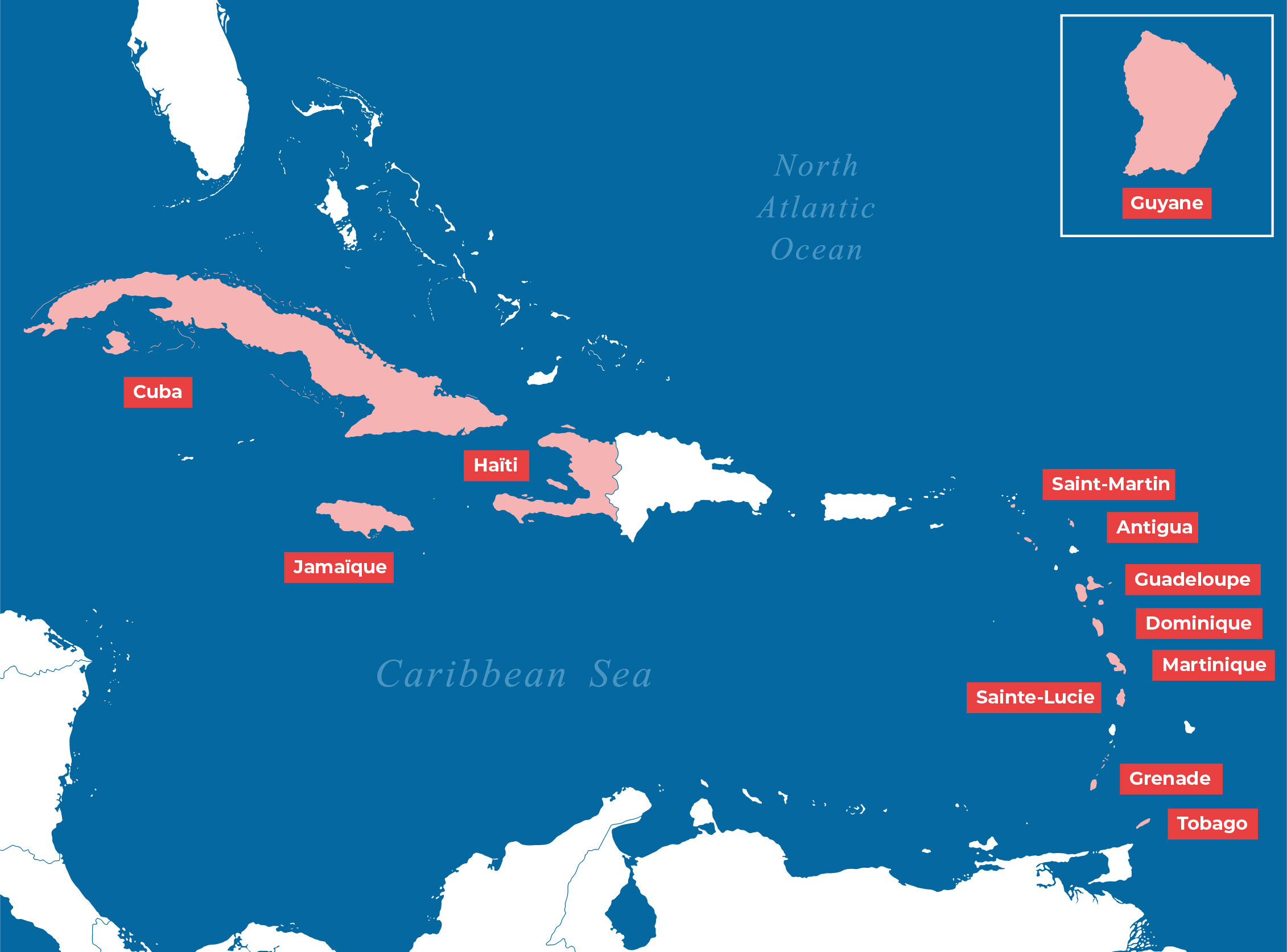
The countries and territories targeted by SHELTER are:
Jamaica, Cuba, Haiti, Saint-Martin, Antigua, Guadeloupe, Dominica, Martinique, Saint Lucia, Grenada, Tobago, French Guiana.
Mobility & Exchanges
SHELTER aims to foster dynamic exchanges between territories, notably through the establishment of exchange programmes:
- for students (master's and doctoral level),
- and for healthcare professionals, between the various centres involved in the management of sickle cell disease.
Target Audiences
SHELTER addresses several complementary audiences, all essential to a structured regional response:
- People living with sickle cell disease and their families , to improve care pathways and access to health services;
- Healthcare professionals of all profiles (physicians, nurses, biologists, midwives, etc.) involved in patient management;
- Researchers, to contribute to a better understanding of the pathophysiology and epidemiology of the disease, within a framework of regional cooperation;
- Public decision-makers, to support the governance of health policies and systems, on the basis of structured information useful for decision-making.
Launch & Resources
This dedicated website serves as the central hub for key SHELTER information:
objectives, territories, partners, resources useful for monitoring, and project news.
It will be presented at the project launch event.